
Facing Parkinson’s: A Proactive Approach to Movement
Receiving a Parkinson’s diagnosis marks the beginning of a journey that presents unique challenges. But beyond the diagnosis, what truly matters is how you navigate daily life. This article isn’t about explaining what Parkinson’s is; instead, it offers a practical and empowering guide to managing its complexities, focusing on essential strategies you can implement to prevent falls and improve your quality of life.
Living with Parkinson’s involves adapting to changes in movement, coordination, and balance. It’s a challenge, but also an opportunity to adopt a proactive approach. The key is to understand that movement is your ally and that every small adaptation counts. It’s not about reversing the disease, but about sustaining your autonomy and well-being for as long as possible through body awareness and action.
Movement is Life: Hidden Challenges and Practical Solutions
One of the most common, yet often underestimated, problems in Parkinson’s is leg weakness that isn’t always directly due to the disease, but to a tendency towards a sedentary lifestyle. This can lead to an unstable posture when standing, with legs too close together, increasing the risk of losing balance.
Key recommendations for movement and safety:
- Train Your Legs and Muscle Strength: Dedicate time to specific exercises that strengthen your legs. This will give you the necessary security to sit down and stand up from a chair, bed, or toilet with greater stability. Simple, repetitive movements, even in a safe environment, are fundamental.
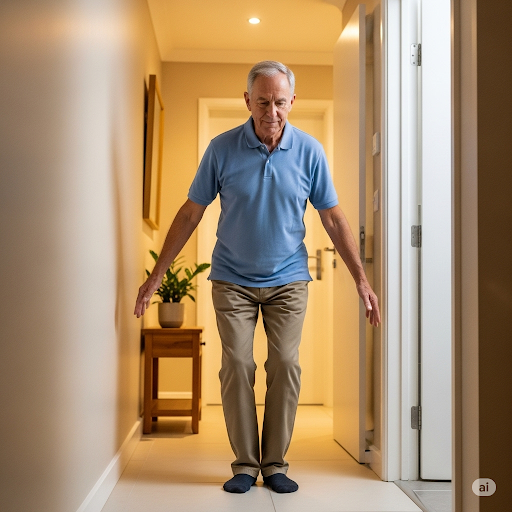
- Adopt an Anti-Gravity Posture When Standing: When getting up, make sure to slightly spread your legs apart. This creates a wider, more stable base of support, which drastically reduces the likelihood of swaying and falling.
- Manage Clumsiness and Rigidity with Patience: Clumsiness and rigidity are symptoms that can make you vulnerable, especially in moments of haste (like when the doorbell rings). Instead of rushing, always prioritize your safety. Take your time. Recognize that your pace for daily tasks might take double, or even longer, than it used to. Plan your routines and move calmly, calculating the time it takes to go from one point in your house to another.
- Improve Shoulder Girdle, Head, and Neck Flexibility: Rigidity in the shoulder girdle, head, and neck is a risk factor. This lack of flexibility can hinder protective arm reflexes in case of a fall. When you hear a sound or need to turn, the tendency might be to do so “in a block,” as a single piece, which destabilizes your center of gravity. Perform gentle rotation and stretching exercises in these areas to allow for smoother turns and maintain balance.
Protecting Your Night: Preventing Risks and Nighttime Falls
Nighttime awakenings to urinate are a significant concern due to the combination of darkness and Parkinson’s movement challenges.
Strategies for a safer night:
- Nighttime Fluid Control: Avoid consuming large amounts of fluids a couple of hours before bedtime to reduce the need to use the bathroom during the night.
- Strategic Oral Hydration: If dry mouth is an issue, keep a small glass of water or ice near your bed just to moisten your mouth, without needing to drink large volumes.
- Lighting and Clear Paths: Make sure the path to the bathroom is well-lit and free of obstacles. Consider using automatic nightlights or easily accessible light switches.
- Bathroom Aids: For those who need them, a bedside commode or a raised toilet seat can reduce the risk of falls by shortening the distance and facilitating transfers.
The First Step Upon Waking: Your Anti-Parkinson’s Morning Routine
Starting your day with conscious movement can make a big difference. You don’t need a gym, just your bed and a little intention.
Recommendations for your morning routine:
- Bed Exercises: Upon waking, sit on the edge of the bed. While listening to relaxing or energizing music, perform gentle muscle movements of your neck and head, rotations of your shoulders, and flexions of your feet (ankles). This helps to “wake up” your body and improve flexibility.
- Conscious Breathing: Incorporate a few minutes of deep, conscious breathing exercises. This not only relaxes but also improves lung capacity and body control.
- “Keep Moving”: This is a vital mantra. Even if you don’t have constant access to an interdisciplinary team, performing simple movements in a safe environment (at home, with furniture support or with a companion if possible) is fundamental. Every movement counts to maintain functionality and reduce stiffness.
This article provides you with practical tools to face the daily challenges of Parkinson’s with greater safety and confidence. However, you are not alone on this journey. In our next article, TS7: Parkinson’s: Navigating Therapies to Sustain Your Quality of Life, we will explore how the support of a team of professionals, including kinesiology, speech-language pathology, and psychological support, is crucial to optimizing your overall well-being.